
CPS IoT Competition Details 🪧
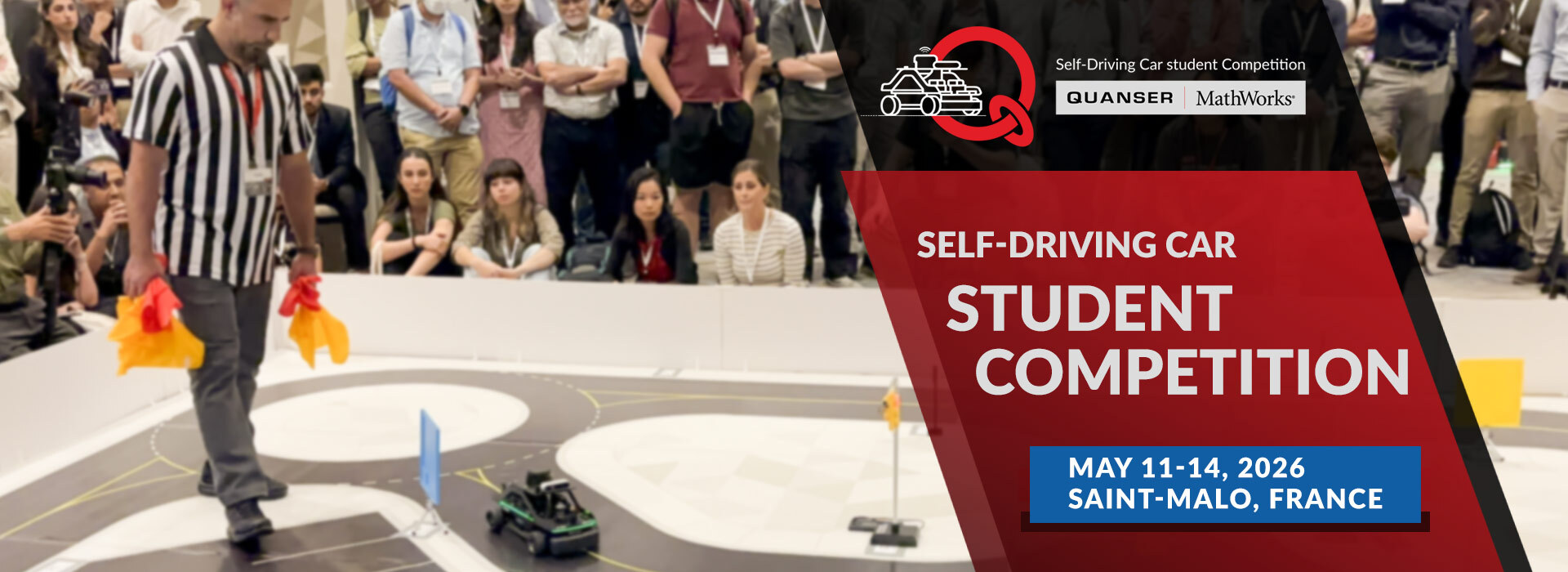
Welcome to the Github Page for the CPS IoT Self-Driving Car Competition. This page will host all competition specific information for the CPS IoT conference.
The competition objective this year is for teams to create a self-driving algorithm in MATLAB/Simulink that is capable of navigating through the Quanser City acting as an autonomous taxi service. Teams will need to maximize their profits within a certain time period.
This document contains the following:
- 🪧 Competition Objective 🪧
- ❗Announcements 🎤
- 🕙 Competition Structure and Timeline 🕙
- 💻 Software Requirements 💻
- ❓ FAQ ❓
- 🗄️ Competition Resources 🗄️
🪧 Competition Objective 🪧
List of Objectives and Rules Resources:
During the virtual stage of this competition, the objective will be to create a video in QLabs that highlights your self-driving algorithm and readiness to compete live at the event. Please use the Virtual Stage Competition Guide as a detailed guide for the expectations.
Finalists will be selected to move on to the physical stage of the competition based on the video submitted during the virtual stage of the competition.
During the physical stage of this competition, the objective will be to implement your self-driving algorithm on the physical QCar 2. The specific task for your self-driving algorithm is laid out in the Physical Stage Competition Guide.
❗Announcements 🎤
- Please watch here for information on registration, MATLAB Technical Resources, and competition specific information.
- Registration Now Live (11/18/2025): CPS IoT Competition Registration
- ONLY MATLAB/Simulink will be supported in this competition and a Mathworks license can be requested from here: MathWorks Student Competition license
- There are currently delays with the technical resources. The new release date will be Dec 1.
- The MATLAB Technical Resources are now released!
- IMPORTANT: To prepare for the competition properly, a Competition Day Guide has been provided containing everything you will need on the day of the in-person event
- From the 2025 ACC Competition the Czech Technical University in Prague submitted the following video and were invited to the Physical Stage of the competition. This video should be treated as a good example of what to show in your Virtual Stage Submission: CVUT Virtual Stage Submission
- The Virtual Stage Video Submission is now March 31st!
- Here is a video going over the resources provided to the teams! MATLAB Competition Resources Overview Video
- Please submit your Youtube video link and Github link to both emails studentcompetition@quanser.com and racinglounge@mathworks.com for the Virtual Stage of this competition.
🕙 Competition Structure and Timeline 🕙
Please see the below table for a timeline containing important dates. Keep in mind that these dates may have slight variations.
| Date | Event | Description |
|---|---|---|
| Nov 18 | Registration Opens | Registration Link: CPS IoT Competition Registration |
| Dec 1 | Release of MATLAB Technical Resources | The MATLAB/Simulink technical resources will be released and students can begin development. |
| Dec 1 - March 31 | Virtual Stage | Teams will develop their self-driving car algorithms in QLabs and submit a video showcasing their algorithm and its readiness. |
| March 31 | Virtual Stage Submission DEADLINE | Teams must submit a video of their virtual performance according to Virtual Submission Requirements and the Software Requirements. |
| April 3 | Finalists Selection and Development | Finalists will be selected based on video submissions to come to CPS IoT in France in person. Teams will continue to develop in the virtual environment until the in-person event. |
| May 12-13 | Conference Workshop | Finalists will come to CPS IoT France and implement their algorithms on a physical QCar 2 with the help of a Quanser Representative. |
| May 14 | Competition Days | Finalists will compete using physical QCar 2s according to the Physical Stage Competition Guide. |
💻 Software Requirements 💻
In this competition ONLY MATLAB/Simulink will be allowed for submissions.
If you need a Mathworks license, you can request one from here: MathWorks Student Competition license
The MATLAB resources can be found here: MATLAB Technical Resources
- Please submit your Youtube video link and Github link to both emails studentcompetition@quanser.com and racinglounge@mathworks.com for the Virtual Stage of this competition.
❓ FAQ ❓
For any competition related inquiries, please email: studentcompetition@quanser.com
🗄️ Competition Resources 🗄️
Competition Documentation:
- CPS IoT Competition Registration
- Request a MathWorks Student Competition license (IMPORTANT)
- Virtual Stage Competition Guide
- Physical Stage Competition Guide
- MATLAB Technical Resources
Mathworks Learning Modules:
- ADAS Learning resources for Students
- How to Parse and Plot Sensor Data in MATLAB
- How to Create Custom Scenes in RoadRunner and Co-simulate with Simulink and Unreal Engine
- How to use Sensor Fusion and Multi Object Tracker
- Onramps
- Computer Vision Training Videos
- Code Generation Training Videos
- Autonomous Navigation
- ROS Implementation
- Perception Video Series
Supporting Documentation: